United Kingdom · guide · 7 September 2026
Can CAR scores increase environmental permit fees?
Yes. CCS (Compliance Classification Scheme) scores from Compliance Assessment Reports accumulate over the calendar year. At year end, your total score determines your compliance band (A to F), and that band affects the subsistence charges you pay for the following year. Source: EA assessing and scoring guidance and EA charging schemes (OGL v3.0).
Free CAR check · £19.99 Full CARBrief · £49.99 Permit + CAR Review — sourced reading only; not EA advocacy or permit drafting.
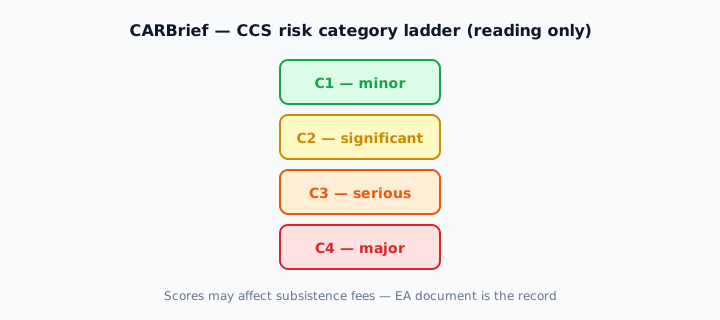
How CCS scoring works
When the Environment Agency records a breach of a permit condition on a CAR, it usually assigns a risk category and score:
- Category 1 — 60 points — major impact.
- Category 2 — 31 points — significant impact.
- Category 3 — 4 points — minor impact.
- Category 4 — 0.1 points — no impact.
Scores from all CARs issued during the calendar year are added together to give a year-to-date total for your site.
Compliance bands and thresholds
At the end of the calendar year, your total CCS score places your site into one of six compliance bands. Published thresholds for waste operations and installations:
- A = 0 points
- B = 0.1 to 10
- C = 10.1 to 30
- D = 30.1 to 60
- E = 60.1 to 149.9
- F = more than 150
Water discharge and other permit regimes may use different band thresholds. Check the EA guidance for your regime.
How bands affect subsistence charges
The EA's annual subsistence charge for your permit is calculated using a base rate for your activity and a multiplier for your compliance band. Published charging schemes set the exact multipliers for each permit regime.
In general:
- Band A may receive a discount (e.g. 0.9× base rate).
- Bands B–D pay standard or slightly increased rates (e.g. 1.0× to 1.5×).
- Bands E and F incur significant increases (e.g. 2.0× to 3.0× or more).
The multiplier applies to the subsistence charge for the year following the year in which the scores were recorded. For example, CCS points accumulated in 2026 determine the band and charge for 2027.
Example
A waste site with a base subsistence charge of £1,600 receives two CARs during the year: one with a C3 score (4 points) and one with a C2 score (31 points). Year-end total: 35 points = band D. If the published multiplier for band D is 1.5×, the subsistence charge for the following year would be £1,600 × 1.5 = £2,400.
This is an illustrative example only. Actual charges depend on your permit regime, activity type, and the published charging scheme in force. This guide does not calculate your fee.
Reducing your compliance band
The EA guidance does not provide a mechanism to remove points once scored. Compliance bands reset at the start of each calendar year, so a high band in one year does not carry forward. The best approach is to address the issues identified on CARs promptly to avoid accumulating further points.
What CARBrief does with scores and bands
We extract all CCS scores from your CAR, calculate your year-to-date total, and project your current compliance band based on published thresholds. We do not calculate subsistence charges or advise how to improve your band.
Common questions
Do CCS scores affect my permit fees?
Yes. CCS scores accumulate over the calendar year and determine your year-end compliance band (A to F). Bands C and above incur higher subsistence charges for the following year. Band A receives a discount.
What are the CCS band thresholds?
For waste and installations: A = 0 points, B = 0.1 to 10, C = 10.1 to 30, D = 30.1 to 60, E = 60.1 to 149.9, F = more than 150 points. Bands are assessed at the end of the calendar year.
How much do permit fees increase for higher bands?
Subsistence charge multipliers vary by permit regime and band. Published EA charging schemes set the exact multipliers for each regime. Generally, band A may receive a discount, while bands E and F incur significant increases.