United Kingdom · guide · 10 September 2026
What CCS scores mean on a CAR form
When the Environment Agency records a permit breach on a CAR, it usually assigns a risk category and a score under the Compliance Classification Scheme (CCS). This note restates the published categories so you can read the form. Source: EA assessing and scoring guidance (OGL v3.0).
Free CAR check · £19.99 Full CARBrief · £49.99 Permit + CAR Review — sourced reading only; not EA advocacy or permit drafting.
The four risk categories (waste operations and installations)
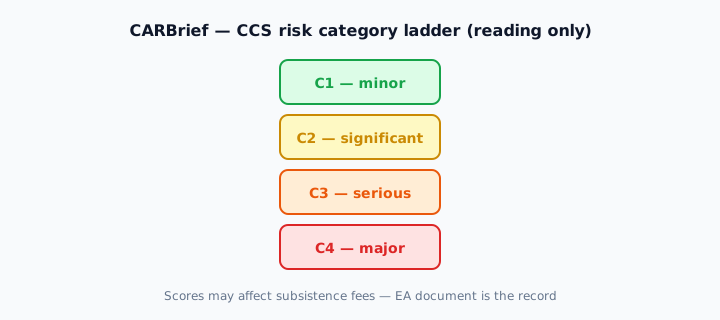
- Category 1 — 60 points — associated with a major impact on human health, quality of life or the environment.
- Category 2 — 31 points — significant impact.
- Category 3 — 4 points — minor impact.
- Category 4 — 0.1 points — no impact on human health, quality of life or the environment.
For most conditions the score reflects the reasonably foreseeable impact if the issue is not addressed. Amenity conditions (odour, dust, noise, pests) are scored on actual impact.
Reading a scored line on the form
A typical non-compliance row prints the permit condition reference, a short description, the risk category (1–4), and the points assigned. Example pattern (illustrative only):
- Condition 3.2.1 — containment failure noted → Category 3 → 4 points.
- Condition 4.1 — odour complaint substantiated on site → amenity scoring on actual impact; category as printed.
CARBrief quotes the category and points exactly as the EA printed them. We do not re-score or downgrade severity. To understand how the condition reference links to your permit, see linking CAR findings to permit conditions.
Emission limit value (ELV) exceptions
ELV breaches follow separate scoring rules in the EA guidance — they are not always consolidated like standard permit conditions. If your CAR lists ELV non-compliances, read the assessing and scoring publication for the ELV table rather than assuming the four-category list above applies unchanged.
Consolidation (one score per condition)
Several findings under one permit condition are usually consolidated into one category and score for that condition (ELVs are treated differently). The form may still list every finding; the scored category is typically the most severe under that condition.
Compliance bands (year end)
Scores accumulate over the calendar year. Published bands for waste/installations subsistence:
- A = 0 points
- B = 0.1 to 10
- C = 10.1 to 30
- D = 30.1 to 60
- E = 60.1 to 149.9
- F = more than 150
Bands affect subsistence charges. See our fees guide for how compliance bands affect EA charges. This guide does not calculate your charge or advise how to improve a band.
What CARBrief does with scores
On the £19.99 full CARBrief (or £49.99 permit + CAR review), we list non-compliances with the severity as printed on the CAR, linked to the condition cited. We do not re-score the EA’s assessment or invent categories. The Free CAR check counts actions and deadlines only — not the full scored reading.
Common questions
Does a Category 3 breach always mean 4 points?
For most waste and installation permit conditions, Category 3 is scored at 4 points under the published Compliance Classification Scheme. Amenity conditions are scored on actual impact — read the category printed on your CAR against the EA guidance.
Can several findings under one condition share one score?
Yes. Several findings under one permit condition are usually consolidated into one category and score for that condition. The form may still list every finding; the scored category is typically the most severe under that condition.
Do CCS scores affect my subsistence charge?
Scores accumulate over the calendar year into compliance bands A–F, which can affect subsistence charges. See can scores increase fees. CARBrief does not calculate your charge.
Informational guide only. Sources: EA assessing and scoring guidance. Last reviewed 10 September 2026. Not legal advice. CARBrief is not the Environment Agency.