United Kingdom · guide · 9 September 2026
How CAR findings link to permit conditions
When the Environment Agency records a non-compliance on a Compliance Assessment Report (CAR), it usually cites the permit condition that was breached. Understanding how the CAR references conditions — and how to find those conditions in your permit — helps you see what requirement applies and what you need to address. This note describes the linking pattern and what CARBrief extracts when you order a Permit + CAR Review.
Free CAR check · £19.99 Full CARBrief · £49.99 Permit + CAR Review — sourced reading only; not EA advocacy or permit drafting.
How a CAR cites permit conditions
A typical CAR non-compliance row includes:
- Condition reference — e.g. "Condition 3.2.1" or "Table S2.1"
- Description of the finding — what was wrong
- Risk category and score — under the Compliance Classification Scheme
- Actions required and deadlines
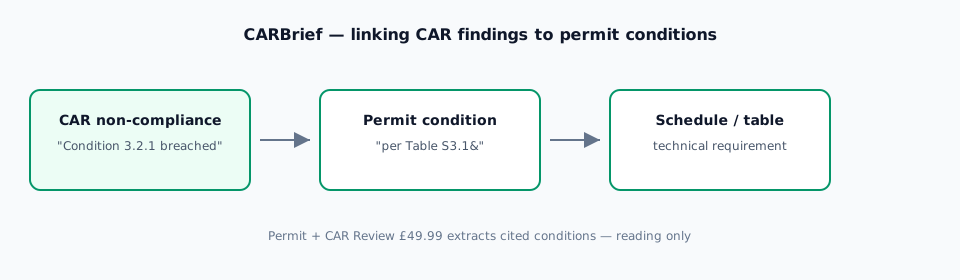
The condition reference is the link between the CAR and your permit. It tells you which legal requirement was not met.
Finding the cited condition in your permit
To locate a cited condition:
-
Note the full condition reference from the CAR
Example: "Condition 3.2.1" or "Schedule 2, Table S2.1". Write it down or copy it.
-
Open your consolidated permit
If your permit is on Public Register Online, download the PDF. Ensure it is the consolidated version (incorporating all variations), not an old issue.
-
Search for the reference
Use Find (Ctrl+F or Cmd+F) in the PDF to search for the condition number. Read the full text of the condition.
-
Check for cross-references to schedules or tables
Many conditions refer to schedules (e.g. "in accordance with Table S3.1"). Find the schedule at the end of the permit to see the detailed requirement.
See our guide to reading a permit for more on permit structure and condition numbering.
Example: linking a CAR finding to the permit
Real-world pattern (illustrative wording from our public sample WE3661AC):
- CAR states: "Condition 3.2 — secondary containment not maintained — Category 3 — 4 points — repair bund by [date]".
- You locate Condition 3.2 in the permit: "All tanks and containers storing liquids shall be provided with secondary containment in accordance with CIRIA C736 or equivalent standard."
- You can now see: what the legal requirement is, that the CAR found it breached, and what action the EA expects by when.
This cross-reference is why having both documents — the CAR and the permit — is important for understanding compliance.
What if the condition reference is unclear?
Sometimes a CAR cites:
- A condition from an older version of the permit that has been renumbered or removed after a variation.
- A table or schedule reference without stating which condition it falls under.
- Multiple conditions consolidated into one scored finding.
If you cannot locate the cited condition in your consolidated permit, or the reference does not match, contact the issuing EA officer for clarification. Do not assume the condition does not apply.
What CARBrief extracts
On the three CARBrief products:
- Free CAR check (£0) — we count actions or non-compliances and note deadlines. We do not extract permit conditions.
- Full CARBrief (£19.99) — we list the CAR findings with the condition references cited by the EA. We do not reproduce the permit wording.
- Permit + CAR Review (£49.99) — we extract the full text of cited conditions and any schedules or tables they reference, cross-referenced to the CAR findings, so you can read the requirement alongside what the CAR says was wrong.
We copy the permit condition wording exactly as published. We do not paraphrase, interpret, or invent conditions. We do not tell you whether the EA assessment is correct or how to fix the breach — that is legal or consultancy advice, which we do not provide.
What CARBrief does not invent
CARBrief is an extract-and-organise service. We do not:
- Invent findings that are not on the CAR.
- Rewrite or simplify permit condition wording.
- Score or re-score non-compliances.
- Advise whether a breach occurred or how to remedy it.
- Interpret what a condition means in the context of your site.
- Tell you whether to appeal or challenge the CAR.
We organise what the EA published. If you need interpretation, remediation advice, or appeal guidance, instruct an environmental consultant or solicitor.
When both documents are needed
The CAR tells you what is wrong. The permit tells you what the rule is. Reading them together shows:
- Which legal requirement was not met.
- What the permit actually requires (including schedules and limits).
- What the EA found during the assessment.
- What actions and deadlines apply.
- What evidence you should keep to show compliance (see what evidence to keep).
The £49.99 Permit + CAR Review does this linking work for you, saving time searching through long permits.
Questions
Will CARBrief tell me if the EA got it wrong?
No. We extract and organise what the EA published. We do not assess whether the finding is accurate or whether the cited condition applies. If you think the CAR is incorrect, raise it with the issuing officer or instruct a solicitor or environmental consultant.
Do I need the Permit + CAR Review if I already have both documents?
The £49.99 Permit + CAR Review extracts the cited conditions and cross-references them with the findings, saving you time searching long permits. If you are comfortable doing that yourself, the £19.99 Full CARBrief lists the findings with condition references but does not extract the permit wording.
What if my permit has been varied and the condition numbers have changed?
Always use the consolidated permit from Public Register Online or your EA area office — it will show the current condition numbering. If a CAR cites a condition you cannot find, ask the issuing officer for clarification.
Is this legal advice?
No. This guide and the CARBrief sourced reading are informational only. The EA documents remain the legal record. If you need advice, instruct a solicitor or environmental consultant.
Informational guide only. Sources: EA assessing and scoring guidance. Public sector information reused under the Open Government Licence v3.0. Last reviewed 9 September 2026. CARBrief is not the Environment Agency.