United Kingdom · guide · 9 September 2026
How to read an environmental permit
An Environment Agency environmental permit is the legal document that sets out the conditions you must meet to operate your site lawfully. Understanding how the permit is structured — its condition numbering, schedules, tables, and references — helps you find what applies to each part of your operation. This is especially useful when a CAR cites a specific condition and you need to locate it in the permit.
Free CAR check · £19.99 Full CARBrief · £49.99 Permit + CAR Review — sourced reading only; not EA advocacy or permit drafting.
Where to find your permit
Most environmental permits are on the public register. For newer permits (waste operations, installations, water discharge activities), search Public Register Online by permit number, operator name, site name, or postcode. See our guide to finding your permit online.
The register usually shows the consolidated permit — the current version incorporating all variations. This is the document you should read alongside any compliance assessment.
Permit structure: front sheet and schedules
A typical permit comprises:
- Front sheet or introductory notice — permit number, operator name, site address, permitted activities, issue and variation dates.
- Conditions — numbered requirements grouped by theme (management, operations, emissions, monitoring, etc.).
- Schedules or tables — detailed technical requirements, emission limits, approved plans, waste types, monitoring frequencies, reporting formats. Schedules are usually at the end of the permit and are referenced by the conditions.
How conditions are numbered
Permit conditions usually follow a hierarchical numbering system. Common patterns:
- 1, 2, 3… — top-level sections (e.g. 1. Management, 2. Operations, 3. Emissions).
- 1.1, 1.2, 1.3… — conditions within a section.
- 1.1.1, 1.1.2… — sub-conditions or clauses within a condition.
When a CAR records a non-compliance, it cites the condition reference (e.g. "Condition 3.2.1"). You use that reference to locate the exact wording in your permit.
Schedules and tables
Schedules expand on conditions. For example:
- Condition 2.3.1 might state "Waste shall be accepted only as listed in Table S2.1".
- You then find Table S2.1 at the end of the permit, which lists every waste code and description that you are allowed to accept.
Schedules commonly include:
- Permitted activities and waste types
- Site plan and infrastructure — approved drawing references
- Emission limits — point source discharge limits, ambient standards
- Monitoring and reporting — parameters, methods, frequencies, notification thresholds
- Improvement conditions — deadlines for specific upgrades or submissions (see improvement conditions guide)
A condition sets the rule; the schedule provides the detail.
Cross-references between conditions and schedules
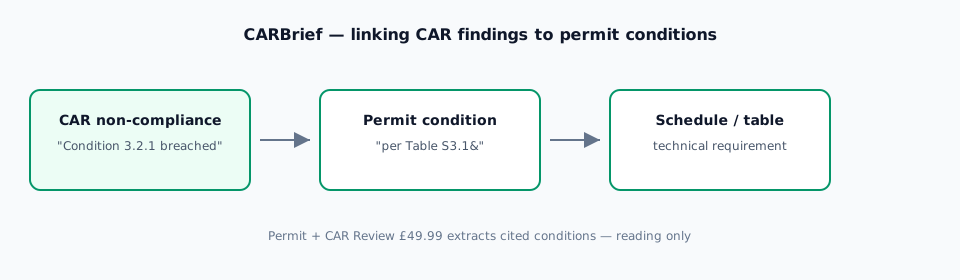
Many permit conditions refer to schedules or other conditions. Example flow:
- CAR states: "Non-compliance with Condition 3.2.1".
- You locate Condition 3.2.1 in the permit: "Secondary containment shall be maintained in accordance with Table S3.1".
- You find Table S3.1, which describes the specification for bunds and drainage.
- The CAR finding makes sense in the context of that technical requirement.
This is why having both the permit and the CAR is important. CARBrief's Permit + CAR Review (£49.99) extracts the cited conditions and schedules so you can see what the CAR is referring to without searching the whole permit.
Common sections in a permit
Most EA environmental permits group conditions into standard themes:
- Management — general management, accident management, competence, training
- Operations — permitted activities, waste acceptance, infrastructure, housekeeping
- Emissions — point source emissions, fugitive emissions, odour, noise, pests
- Monitoring — what to measure, how, how often, what records to keep
- Information and reporting
This grouping mirrors the structure of a CAR form, where findings are recorded under similar headings.
Finding a cited condition quickly
When a CAR or enforcement letter cites a condition:
- Note the full reference (e.g. Condition 3.2.1 or Table S2.1).
- Open the consolidated permit PDF and use Find (Ctrl+F or Cmd+F) to search for that reference.
- Read the condition in full — including any cross-referenced schedules.
- Check whether the schedule or table is on the same page or later in the document.
If your permit is long or has been varied many times, the consolidated version from Public Register Online is usually easier to navigate than older paper copies.
What CARBrief does with permit conditions
On the Free CAR check, we count actions and deadlines but do not extract permit conditions. On the £19.99 Full CARBrief, we note which conditions are cited but do not reproduce the permit wording. On the £49.99 Permit + CAR Review, we extract the full text of cited conditions and schedules, cross-referenced to the CAR findings, so you can read both documents side by side. We do not modify or interpret the legal wording of your permit.
Questions
Where do I find the consolidated permit?
For most waste, installation, and water discharge permits, the consolidated permit is on Public Register Online. Search by permit number or operator name. If not online, contact your EA area office or request it under environmental information regulations.
Why does the CAR cite a condition I can't find?
Ensure you are reading the consolidated permit as varied, not an older version. Condition numbers can change after variations. If the condition is still missing, check whether it references a schedule or table. If uncertain, ask the issuing EA officer for clarification.
Will CARBrief show me which conditions were breached?
Yes. On the £19.99 Full CARBrief, we note which conditions are cited by the CAR. On the £49.99 Permit + CAR Review, we extract the full text of those conditions from your permit and cross-reference them with the findings.
Is this legal advice?
No. This guide and the CARBrief sourced reading are informational only. Your permit is the legal document. If you need advice, instruct a solicitor or environmental consultant.
Informational guide only. Sources: Environment Agency standard permit templates and management systems guidance. Public sector information reused under the Open Government Licence v3.0. Last reviewed 9 September 2026. CARBrief is not the Environment Agency.