United Kingdom · guide · 14 September 2026
Improvement conditions on environmental permits — reading literacy
An improvement condition (often labelled IC1, IC2, or similar on EA permits) is a permit requirement with a fixed deadline to complete a specific upgrade, submission, or change. Many permits issued or varied from 2024 onwards include improvement conditions for Best Available Techniques (BAT) compliance or site upgrades. This note explains how ICs are described on published permit documents so you can read the deadlines and milestones on your PDF. Source: EA standard permit templates and management systems guidance (OGL v3.0).
Improvement conditions vs standard permit conditions
On published EA permits, conditions fall into broad types:
- Standard conditions — ongoing requirements that apply from permit issue (or from a stated date) with no fixed end date. Examples: maintain containment, keep records, operate within emission limits.
- Table or schedule conditions — technical detail in schedules (waste codes, emission limits, monitoring frequencies). See our guide to reading a permit.
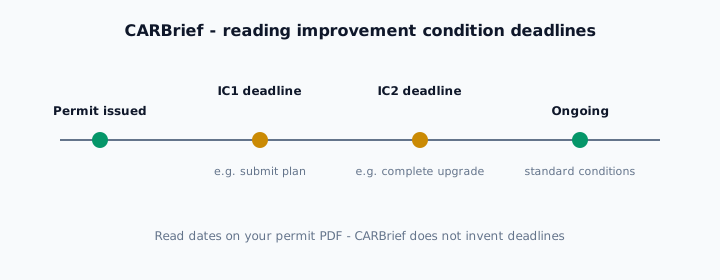
- Improvement conditions — time-bound milestones requiring a specific action by a calendar date. Examples: submit a management plan by 31 March 2026, complete a plant upgrade by 30 September 2027, install abatement equipment by a stated quarter.
Improvement conditions are legal requirements like any other permit condition. The difference is the deadline structure — you must complete the stated action by the date printed on the permit. This guide explains how to read those dates; it does not advise how to achieve BAT or whether your engineering meets the requirement.
Free CAR check · £19.99 Full CARBrief · £49.99 Permit + CAR Review — sourced reading only; not EA advocacy or permit drafting.
How ICs appear on permit PDFs
Improvement conditions are usually grouped in a dedicated section or schedule. Common patterns on EA permits:
- IC numbering — labelled IC1, IC2, IC3 (or Improvement Condition 1, 2, 3) in the conditions or in Schedule 1 (improvement programme).
- Action required — what you must do (e.g. "submit a written management plan", "install secondary containment to specification X", "commission abatement plant").
- Deadline date — a specific calendar date (e.g. 31 March 2026) or "within [N] months of permit issue".
- Cross-references — ICs may refer to approved drawings, BAT conclusions, or tables elsewhere in the permit.
Always read the consolidated permit from Public Register Online — variations may add, amend, or complete ICs. Older paper copies may not show the current deadlines.
Reading past vs future IC deadlines
When you open your permit, check each IC against today's date:
-
Locate the improvement conditions section
Search the PDF for "IC", "improvement condition", or "Schedule 1" (common on waste and installation permits).
-
Note each deadline date
Write down IC reference, required action, and deadline. Check whether a variation has extended or completed an IC.
-
Distinguish completed from outstanding ICs
If an IC deadline has passed, the permit may record completion in a variation notice, or the EA may have issued a compliance assessment. Read the consolidated permit and any CARs on the register — do not assume completion without a published record.
-
Plan for future ICs
Future deadlines are ongoing legal requirements. This guide does not advise project planning, capital expenditure, or how to negotiate extensions — those are operational or consultancy decisions.
Why permits include improvement conditions
Published EA decision documents and permit templates describe improvement conditions where:
- A site is permitted to operate now but must upgrade infrastructure or processes by a stated date.
- BAT conclusions require phased compliance — immediate operation under interim limits with a deadline to meet full BAT.
- A permit variation or new issue sets a programme of works (e.g. install monitoring, submit plans, complete civil works).
ICs appear on both standard rules and bespoke permits, though bespoke permits often have more site-specific improvement programmes. This guide does not advise which permit type to hold or whether an IC is achievable.
ICs and Compliance Assessment Reports
A CAR records compliance with permit conditions assessed during an inspection. CARs typically cite standard operational conditions breached on the day of assessment. Improvement conditions may appear on a CAR if:
- An IC deadline has passed and the required action was not completed or evidenced.
- The officer assessed progress against an outstanding IC during the visit.
CARs do not usually list every future IC deadline — those remain on the permit until the date passes or the IC is completed. To read how CAR findings cite conditions, see linking CAR findings to permit conditions.
What this guide does not cover
This is a literacy guide on reading published EA materials. It does not cover:
- How to achieve BAT or design engineering solutions for an IC.
- How to apply for an extension or variation to an IC deadline.
- Whether an IC has been met to the EA's satisfaction — read the permit, CARs, and any EA correspondence on the register.
- Enforcement, appeals, or how to challenge a non-compliance finding.
What CARBrief does with improvement conditions
CARBrief reads environmental permits and CARs. On the three products:
- Free CAR check (£0) — count of actions or non-compliances plus deadlines from your CAR.
- Full CARBrief (£19.99) — CAR findings with cited condition references; does not extract full permit wording or list all IC deadlines.
- Permit + CAR Review (£49.99) — extracts cited permit conditions (including ICs if cited on the CAR) and cross-references them with findings. Useful when a CAR records non-compliance with an improvement condition or a condition that references an IC schedule.
We copy permit condition wording exactly as published. We do not invent deadlines, paraphrase IC requirements, or advise whether you are on track to meet them.
Questions
What is an improvement condition on a permit?
An improvement condition is a time-bound permit requirement — usually labelled IC1, IC2, or similar — requiring a specific action by a stated deadline. Examples include submitting a plan, installing equipment, or completing an upgrade by a calendar date printed on the permit.
Where do I find IC deadlines on my permit?
Search your consolidated permit PDF for "improvement condition", "IC", or "Schedule 1". Each IC should state the required action and deadline date. Download the current consolidated version from Public Register Online.
Will a CAR list my improvement condition deadlines?
CARs focus on compliance assessed during the inspection. Future IC deadlines remain on the permit. A CAR may cite an IC if the deadline has passed and the action was not completed, or if the officer assessed IC progress during the visit.
Will CARBrief extract all my IC deadlines?
The £49.99 Permit + CAR Review extracts conditions cited on the CAR and cross-references them with your permit. It does not produce a standalone IC deadline tracker for every IC on the permit unless those ICs are cited on the CAR. For full permit literacy, read the improvement conditions section of your consolidated permit PDF.
Is this legal advice?
No. This guide and the CARBrief sourced reading are informational only. Your permit is the legal document. If you need advice on meeting an IC or responding to enforcement, instruct a solicitor or environmental consultant.
Informational guide only. Sources: Environment Agency standard permit templates; GOV.UK — develop a management system (environmental permits). Public sector information reused under the Open Government Licence v3.0. Last reviewed 14 September 2026. CARBrief is not the Environment Agency.