United Kingdom · guide · 23 September 2026
When to vary your environmental permit — reading literacy
An environmental permit authorises specific activities at a defined site under stated conditions. When something material changes — the waste you handle, the throughput, the equipment, or the site layout — published Environment Agency materials usually describe that as a trigger for a variation rather than something you can do under the existing permit alone. This guide explains how GOV.UK and EA guidance describe those triggers so you can read your situation against published sources. It does not tell you whether your site needs a variation or how to complete an application. Sources: GOV.UK — Change an environmental permit; GOV.UK — Environmental permit application overview (OGL v3.0).
Free CAR check · £19.99 Full CARBrief · £49.99 Permit + CAR Review — sourced reading only; not EA advocacy or permit drafting.
What a variation is on published EA materials
On GOV.UK, a variation is a formal change to an existing permit. It is distinct from:
- Routine operation — running the site within the activities, limits, and conditions already printed on your consolidated permit.
- A new permit — required when there is no existing permit for the activity (or when published guidance treats the change as substantial enough to require a fresh application rather than a variation).
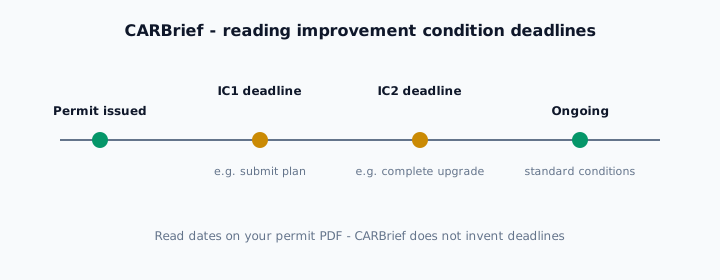
- An improvement condition deadline — a time-bound requirement already on the permit. Meeting an IC by its printed date is compliance with the existing permit, not necessarily a separate variation — though a variation may have added the IC in the first place. See improvement conditions on permits.
Published EA decision documents and variation notices usually list what changed — new conditions, amended limits, added activities, or removed authorisations. This guide helps you recognise when published guidance points toward a variation; it does not assess your site.
Common triggers described on GOV.UK
EA guidance on changing a permit describes situations that typically require a variation application. Read the current GOV.UK page for the full list; common categories include:
- Change of activity or waste type. Handling a waste code, process, or material not authorised on the current permit — or exceeding tonnage or throughput limits in the permit tables.
- Site or infrastructure change. New buildings, altered drainage, additional bays, changed containment, or modified abatement plant that affects how the permitted activity is carried out.
- Change of operator details where the permit ties authorisation to named parties. Some changes are administrative; others require EA assessment — published guidance distinguishes them.
- Change between standard rules sets or to/from bespoke. Moving to a different standard rules permit reference, or from standard rules to bespoke (or vice versa), is usually a formal change process. See standard rules vs bespoke permits.
- Emission limit or monitoring change. New stack tests, altered ELVs, or different monitoring frequencies beyond what conditions already allow.
Literacy discipline: if published guidance says a change “may require a variation”, that is not a confirmation that your site must apply — it is a signpost to read your permit and the GOV.UK process pages. CARBrief does not bridge that gap for you.
Reading your permit before assuming a variation is needed
Before treating any site change as requiring a variation, read the consolidated permit from Public Register Online:
-
Check the activity description and schedules
Does the change fall within activities, waste codes, and limits already authorised? Some permits authorise broad categories; others are tightly bounded.
-
Check conditions for “prior approval” or “notify the regulator” wording
Some permits allow certain changes only after EA approval or notification — which may still be a variation or a formal approval under an existing condition. Quote the condition as printed. See how to read a permit.
-
Check whether a variation notice already exists on the register
Prior variations may have added the capacity or activity you plan to use. Download the latest consolidated PDF — not an old paper copy.
-
Check CAR history for cited conditions
A CAR may record operation outside permitted limits — which can signal a mismatch between what the site does and what the permit authorises. That is a literacy cue to re-read the permit, not automatic proof a variation was needed. See linking CAR findings to permit conditions.
Variation vs new application — how published materials describe the split
GOV.UK guidance describes some changes as variations to an existing permit and others as requiring a new application — for example when the activity is substantially different, the site is new, or the operator cannot vary the existing permit type. Published decision documents usually state which route was taken.
This guide does not advise which route applies to your site. If the EA’s published materials and your permit text leave the position unclear, that is a question for the EA’s published contact routes or for professional advice — not for CARBrief.
What appears on the register after a variation
When the EA grants a variation, Public Register Online typically shows:
- A variation decision document or notice — stating what changed and any new or amended conditions.
- An updated consolidated permit PDF — the legal document incorporating the change.
- Sometimes a public consultation record for substantial changes — described on GOV.UK process pages.
CARBrief reads the permit and CAR you send. We cite condition wording as published. We do not track variation applications in progress or advise on application strategy.
What this guide does not cover
This is a literacy guide on reading published EA materials. It does not cover:
- How to complete a variation application form or technical annex.
- Application fees, timescales, or how to respond to EA requests for information.
- Whether your specific site change requires a variation — read your permit and GOV.UK guidance, or instruct a consultant.
- Enforcement, appeals, or how to challenge a refusal.
- Planning permission or waste exemption registration — adjacent regimes with their own published rules. See what is a waste exemption? for exemption literacy.
What CARBrief does with permit variations
CARBrief reads environmental permits and CARs — not variation applications in draft. On the three products:
- Free CAR check (£0) — count of actions or non-compliances plus deadlines from your CAR.
- Full CARBrief (£19.99) — CAR findings with cited condition references.
- Permit + CAR Review (£49.99) — extracts cited permit conditions and cross-references them with CAR findings. Useful when a CAR cites conditions added or amended by a variation.
We copy permit condition wording exactly as published on the consolidated permit you provide. We do not advise whether a variation is needed or draft variation submissions.
Questions
What is a permit variation?
On published EA materials, a variation is a formal change to an existing environmental permit — for example new activities, changed limits, or site alterations. It is not the same as routine compliance with existing conditions.
How do I know if my site change needs a variation?
Read your consolidated permit and the current GOV.UK change-an-environmental-permit guidance. Compare the change against authorised activities, waste codes, limits, and conditions. This guide describes how published materials frame the question — it does not answer it for your site.
Is a variation the same as meeting an improvement condition?
Not necessarily. An improvement condition is a deadline on the existing permit. A variation may have added that IC, but completing the IC by its printed date is compliance with the permit you hold — not a new variation unless published guidance or your permit says otherwise.
Will CARBrief advise whether we need a variation?
No. CARBrief reads permits and CARs. We do not assess your site changes, draft variation applications, or advise whether a variation is required for your circumstances.
Is this legal advice?
No. This guide and the CARBrief sourced reading are informational only. Your permit is the legal document. If you need advice on variations or compliance, instruct a solicitor or environmental consultant.
Informational guide only. Sources: GOV.UK — Change an environmental permit; GOV.UK — Environmental permit application overview. Public sector information reused under the Open Government Licence v3.0. Last reviewed 23 September 2026. CARBrief is not the Environment Agency.