United Kingdom · guide · 22 September 2026
Reading odour, dust and noise findings on a CAR
Amenity findings — odour, dust, noise and pests — appear on Compliance Assessment Reports (CARs) under the amenity assessed area. Unlike most permit breaches, they are scored on actual impact, not reasonably foreseeable impact. This note helps you read what the EA recorded, how C2 and C3 categories apply, and how to link findings to your permit. Source: EA assessing and scoring guidance (OGL v3.0).
Free CAR check · £19.99 Full CARBrief · £49.99 Permit + CAR Review — sourced reading only; not EA advocacy or permit drafting.
Where amenity findings appear on the form
On a CAR, permit conditions are grouped into high-level assessed areas. Amenity covers odour, dust, noise, vibration, light and pests. The form marks each sub-criterion as assessed (A), not assessed (N), not applicable (NA), or ongoing (O). If the EA found a breach, a non-compliance row appears with:
- The permit condition reference (e.g. Condition 4.1 or a schedule table).
- A description of what was observed — complaint substantiation, monitoring exceedance, or officer assessment on site.
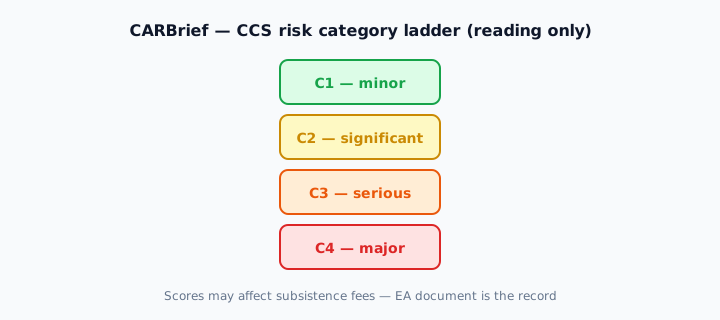
- A risk category (1–4) and points under the Compliance Classification Scheme.
- Actions required and a deadline.
See our guide to reading a CAR for the full form layout.
Actual impact vs foreseeable impact
For most permit conditions, the EA scores breaches on the reasonably foreseeable impact if the issue is not addressed. Amenity conditions are different: the category reflects actual impact at the time of assessment.
That means an amenity finding usually describes what the officer observed or substantiated — for example, odour detected beyond the site boundary, dust deposition on neighbouring property, or noise exceeding a permit limit during the visit. The printed category (often C3 at 4 points for minor actual impact, or C2 at 31 points for significant actual impact) is what CARBrief extracts. We do not re-score or downgrade severity.
Reading odour findings
Odour non-compliances typically cite a permit condition requiring odour management, abatement, or limits on offensive odour beyond the site. On the CAR you may see:
- Reference to a complaint log or community report the officer investigated.
- Whether odour was detected on site, at the boundary, or at a receptor location.
- Whether abatement equipment was operating correctly.
- The assigned category — a substantiated significant odour impact may appear as Category 2 (31 points).
Illustrative pattern only:
- CAR states: "Condition 4.2 — offensive odour detected at site boundary during inspection — Category 2 — 31 points — review odour management plan by [date]".
- You locate Condition 4.2 in the permit: read the full wording via linking CAR findings to permit conditions.
- You can now see: what the permit requires, what the EA observed, the severity assigned, and the stated deadline.
Reading dust and particulate findings
Dust findings often relate to permit conditions on emissions to air, site cleanliness, or operational controls during handling, storage, or processing. The CAR may note visible dust beyond the site, failure to use suppression, uncovered stockpiles, or particulate monitoring results. Scoring follows actual impact: minor dust with limited off-site effect may be Category 3; significant deposition or repeated breach may be Category 2.
Dust and odour findings sometimes appear on the same CAR after a single inspection if several amenity sub-criteria were assessed. Each may be listed separately, but findings under one condition are usually consolidated into one score for that condition.
Reading noise and vibration findings
Noise non-compliances cite permit conditions setting limits, operating hours, or requirements for noise management plans. The CAR may reference:
- Measured noise levels compared to permit limits or British Standards referenced in the permit.
- Operations outside permitted hours.
- Failure to maintain noise mitigation (barriers, enclosures, silencers).
As with odour and dust, the category reflects actual impact recorded at assessment. A single noise exceedance with significant off-site effect may score differently from a minor technical breach with no measured impact.
C2 and C3 amenity scoring literacy
Understanding the two most common amenity categories helps you read the form without re-interpreting the EA assessment:
- C3 — Category 3 — 4 points — minor actual impact on human health, quality of life or the environment.
- C2 — Category 2 — 31 points — significant actual impact.
A single C2 amenity score adds 31 points to your year-to-date CCS total. Combined with other scores in the same calendar year, it can affect your compliance band and subsistence charges — see can scores increase fees. This guide does not calculate your band or advise how to reduce scores.
What the CAR does not always show
The CAR records the EA officer's assessment at a point in time. It may not include full complaint histories or continuous monitoring graphs. For evidence you should retain after an amenity finding, see what evidence to keep. This guide does not advise whether a finding is fair or how to design abatement — that is legal or consultancy advice.
What CARBrief does with amenity findings
We extract amenity non-compliances exactly as printed — condition reference, description, category, points, actions and deadlines. We do not re-score based on complaint severity or invent findings.
On the three products:
- Free CAR check (£0) — count of actions or non-compliances plus deadlines.
- Full CARBrief (£19.99) — amenity findings with cited condition references, severity as printed, deadlines, checklist.
- Permit + CAR Review (£49.99) — extracts cited permit conditions (including odour, dust and noise limits) cross-referenced to CAR findings.
Common questions
Are odour and noise findings scored differently from other CAR breaches?
Yes. Amenity conditions — odour, dust, noise and pests — are scored on actual impact rather than reasonably foreseeable impact. The category and points printed on the CAR reflect what the EA officer recorded at assessment.
What does a C2 amenity finding mean on a CAR?
C2 is risk category 2 (31 points). On amenity conditions it indicates the EA recorded a significant actual impact on human health, quality of life or the environment from odour, dust, noise or pests. CARBrief quotes the category exactly as printed; we do not re-score.
Can several amenity complaints share one score on the CAR?
Several findings under one permit condition are usually consolidated into one category and score for that condition. The form may list every complaint or observation, but the scored line is typically the most severe category under that condition.
Will an amenity C2 score affect my permit fees?
CCS scores accumulate over the calendar year. At year end, your total score determines your compliance band (A to F). Bands C and above can increase subsistence charges. See can scores increase fees.
Informational guide only. Sources: EA assessing and scoring guidance. Public sector information reused under the Open Government Licence v3.0. Last reviewed 22 September 2026. CARBrief is not the Environment Agency.