United Kingdom · guide · 22 September 2026
Reading pollution incident and containment findings on a CAR
Pollution incident response and containment failures are among the most consequential findings on a Compliance Assessment Report (CAR). They appear under incident management and infrastructure assessed areas and are usually scored on reasonably foreseeable impact if not addressed. This note helps you read what the EA recorded — without advising how to respond to an incident or challenge enforcement. Source: EA assessing and scoring guidance (OGL v3.0).
Free CAR check · £19.99 Full CARBrief · £49.99 Permit + CAR Review — sourced reading only; not EA advocacy or permit drafting.
Two types of finding: response and containment
Pollution-related CAR findings generally fall into two groups:
- Incident response — whether the operator reported an incident, followed the pollution incident plan, contained spread, and met notification timescales in the permit.
- Containment and infrastructure — whether secondary containment, bunds, drainage, tanks, pipelines and other infrastructure were maintained to prevent or limit pollution.
Both may appear on the same CAR after a site inspection triggered by an incident, a routine audit, or follow-up to a previous finding. See our guide to reading a CAR for how assessed areas are marked on the form.
Reading incident response findings
Permits typically require a pollution incident plan and prompt notification to the EA when certain events occur. On the CAR, an incident response non-compliance may describe:
- Failure to notify the EA within the timescale stated in the permit.
- An outdated or unavailable pollution incident plan.
- Staff unable to locate or follow the plan during the assessment.
- Inadequate records of an incident the EA investigated.
- Failure to submit a post-incident report where the permit requires one.
Illustrative pattern only:
- CAR states: "Condition 1.5 — pollution incident not reported within 24 hours — Category 3 — 4 points — update incident plan and submit records by [date]".
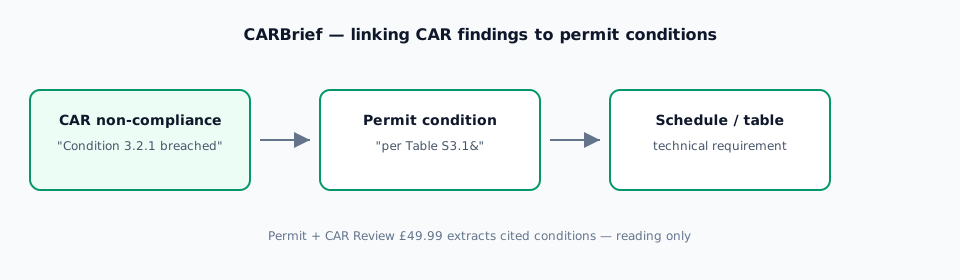
- You locate Condition 1.5 in the permit: read notification requirements and plan content via linking CAR findings to permit conditions.
- You can now see: what the permit required, what the EA found, the severity assigned, and the stated deadline.
The CAR describes the EA officer's assessment, not a full incident investigation report. Detailed chronology or sampling results may appear in separate EA correspondence.
Reading containment failure findings
Containment findings cite permit conditions on secondary containment, bund integrity, drainage isolation, tank and container standards, and infrastructure maintenance. Common CAR descriptions include:
- Bund cracks, insufficient freeboard, or inadequate capacity.
- Drains not sealed or valve failure preventing isolation.
- Containers stored without required secondary containment.
- Evidence of previous spill not cleaned or contained.
- Foreseeable risk of liquid or waste escape to land or water.
Containment breaches are scored on reasonably foreseeable impact — unlike amenity findings, which use actual impact. A minor defect with limited foreseeable consequence may appear as Category 3 (4 points). A significant foreseeable risk of pollution beyond a minor incident may appear as Category 2 (31 points). See what CCS scores mean for all four categories.
Linking findings to permit conditions
Every non-compliance row should cite the breached condition. Pollution and containment conditions often cross-reference schedules — for example, bund specifications in a table at the end of the permit. To read the full requirement:
-
Note the condition reference from the CAR
Example: "Condition 3.2" or "Table S2.1".
-
Open your consolidated permit
Download from Public Register Online or request from your EA area office.
-
Read the condition and any referenced schedules
See how to read a permit for structure and numbering.
The £49.99 Permit + CAR Review extracts cited conditions and cross-references them to CAR findings so you can read the requirement alongside what the EA recorded.
Actions, deadlines and follow-up
Pollution and containment findings usually include specific actions — repair a bund, submit a revised incident plan, provide photographs, or commission an inspection — with a deadline. See CAR response deadlines for reading literacy on timescales and follow-up inspections.
The CAR may also state that enforcement is being considered. A CAR is a compliance record, not an enforcement notice. If you receive a separate enforcement document, instruct a solicitor. This guide does not advise on enforcement strategy or whether to accept or challenge a finding.
Scoring and year-end bands
A single C2 containment finding (31 points) can place a site in compliance band C or D depending on other scores that calendar year. Multiple infrastructure findings under one condition are usually consolidated into one category and score for that condition. See can scores increase fees for how bands affect subsistence charges. CARBrief lists scores as printed; we do not re-score or calculate your charge.
What CARBrief does with incident and containment findings
We extract non-compliances exactly as printed — condition reference, description, category, points, actions and deadlines. We do not invent findings, soften language, or advise how to respond to an incident.
On the three products:
- Free CAR check (£0) — count of actions or non-compliances plus deadlines.
- Full CARBrief (£19.99) — findings with cited condition references, severity as printed, deadlines, checklist.
- Permit + CAR Review (£49.99) — extracts cited permit conditions (including incident plan and containment requirements) cross-referenced to CAR findings.
Common questions
Where do pollution incident findings appear on a CAR?
Pollution incident response and containment findings usually appear under the incident management and infrastructure assessed areas on the CAR. Each non-compliance row cites a permit condition, describes the failure, assigns a CCS category and points, and states actions and deadlines.
How are containment failures scored on a CAR?
Containment and infrastructure breaches are typically scored on reasonably foreseeable impact if not addressed. A minor bund defect with limited foreseeable risk may be Category 3 (4 points). A significant foreseeable risk of pollution escape may be Category 2 (31 points). CARBrief quotes the category exactly as printed.
Does a CAR record whether I reported a pollution incident to the EA?
The CAR may note whether an incident was reported, whether the pollution incident plan was followed, and whether notification timescales in the permit were met. Read the finding description and cited condition against your permit. CARBrief extracts what the EA printed; we do not assess whether reporting was adequate.
Is a CAR the same as an enforcement notice after a spill?
No. A CAR is a compliance assessment record. An enforcement notice is a separate legal document requiring action under statute. The CAR may state that enforcement is being considered. If you receive an enforcement notice, instruct a solicitor.
Informational guide only. Sources: EA assessing and scoring guidance; EA Enforcement and Sanctions Policy. Public sector information reused under the Open Government Licence v3.0. Last reviewed 22 September 2026. CARBrief is not the Environment Agency.